

This blog post is an attempt to present succinctly the misadventures of the translation of a key term in Alf Ross’ most famous book – some would say, his best and most important one – Om ret og retfærdighed (originally published in 1953).
The original and the problems of its translations

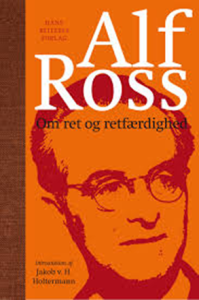
Om ret og retfærdighed was translated in several languages.
It was originally translated into English in 1958 and, then received a second translation in 2019 (On Law and Justice); in Spanish, by the Argentinian legal philosopher Genero Carrió, in 1963 (Sobre el Derecho y la Justicia); and in Italian, by Giacomo Gavazzi, in 1965 (Diritto e Giustizia).
Of all these translations, only the Argentinian one is truly faithful to Ross’ meaning of the key term in question – in other words, it is the only one among the mentioned translations that transmits adequately what Ross was trying to say in his book.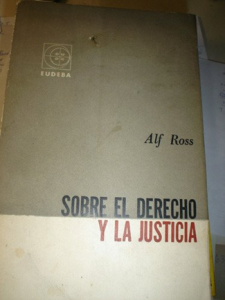
The others are plagued by wrong – or, at best, highly misleading – translations of the term and, as such, have contributed to a poor understanding of Ross’ theory in the common law world and great part of the civil law one too.
For a long time, only members of the so-called School of Buenos Aires and those who learned from them (like some members of the Genoa School like Giovanni Tarello and Riccardo Guastini) were able to actually use Ross’ theory and concepts in the way that they were originally framed by the author. The most recent English translation (2019) was supposed to help rectify this, at least in the common law world; but, alas, it only brought more confusion to the matter.
The key term in question is the Danish word ‘gældende’. Let us begin.
Properties of Legal Norms in Ross’ theory
One of the central points of Om ret og retfærdighed (from now on, ORR) is its treatment of some important properties of legal norms. Indeed, Ross distinguishes between two different and relevant properties, which expressed by the Danish terms ‘gyldig’ and ‘gældende’ respectively.
‘Gyldig’
The first of these terms, ‘gyldig’, can be read as equivalent to ‘valid’ in a colloquial sense – not as a lawyer would use it, but as a layman would. In this sense, it is a multi-purpose concept, which could be read as ‘belonging’, ‘applicable’ and/or ‘mandatory’.
Indeed, it is what we may call a “Victorinox Term”: a term with many uses, not necessarily contradictory with each other in layman’s parlance.
For legal theory, ‘gyldig’ could be understood as denoting the property of legal validity of a legal norm. Legal validity is, as Eugenio Bulygin (2015) says, a very confusing term that can mean at least three things:
1) The fact that a legal norm satisfies the criteria of membership a given legal system.
2) The fact that a legal norm must be used to resolve a particular legal controversy because it is mandated by another legal norm of the same legal system.
3) The fact that a legal norm must be obeyed because it has some kind of obligatory force.
These meanings are somewhat in accordance with the layman understanding but clearly differentiated and (a bit) more refined.
‘Gældende’
In contrast, the second of these terms, ‘gældende’, is a term that Ross defines in a stipulative manner (or explanatory in Carnap’s sense, according to the editor of the new translation – with whom I agree on this point).
According to Ross himself, ‘gældende’ can be understood as equivalent of ‘effective’, ‘in force’ and similar other terms in other languages (vigente, both in Spanish and Italian). He states this in his essay ‘Validity and the Conflict between Legal Positivism and Natural Law’, originally published in the Revista Jurídica de Buenos Aires (1961, 46), which he wrote after his visit to the University of Buenos Aires invited by Ambrosio Gioja, the chair of legal philosophy. The essay was published in the same number of the journal both in English and Spanish, translated by Carrió.
‘Valid’?
Why am I bringing this up? Well, because the original English translation of ORR (by a translator whose name I do not wish to remember – but was Margaret Dutton) does not distinguish between ‘gyldig’ and ‘gældende’, and translates both terms as ‘valid’ without any qualifications. This choice, unfortunately, ruins Ross’ arguments in the book.
Let us see this in detail.
The kernel of the matter: Ross’ argument
Positive law and two sets of legal norms
Ross’ argument in a way runs as follows. There are two sets of legal norms that form the positive law of a given community. First, the set of gyldig/valid laws, those that are considered as members of the legal systems due to them satisfying the criteria of membership of said system (just to mention one of the senses of ‘gyldig’). It is basically the set of formal valid norms of a legal system.
There is another set composed of the legal norms that are actually used by judges to resolve controversies. Those are the laws that are considered in force due to the fact that those laws are used by the judges to justify their decisions. This fact is recorded by the legal science of a given community, detailing which norms are used or not used by judges. This is the set of gældende legal norms.
The importance of distinguishing the sets
This distinction is the kernel of his realist argument. The importance of distinguishing those norms that are formally valid (the idea of positive law that is ideologically presented as being the positive law at any given community) and those norms that are the positive law of the community due to the fact that they are actually used within the community to resolve controversies of law (the real positive law of the community).
The whole theory of norms of ORR is built on this distinction. Both sets do not have to overlap completely. Some gyldig legal norms are also gældende legal norms, but not all gældende legal norms are gyldig legal norms. There is an important difference on how the law of a community presents itself (gyldig) with what the law of that community actually is (gældende).
The problem of not distinguishing the sets
Unfortunately, because of the choice of translating both terms as a single same one without qualifications (‘valid’) this distinction is completely lost in the English translation of 1958 and in the Italian one from 1965, which is based on the English 1958 edition instead of the Danish 1953 original. As such, both translations ended up completely misrepresenting Ross’ theory.
Indeed, what comes up from this is the warped image that, for Ross, the valid (in formal sense) legal norms of a legal system are (1) those that satisfy the membership criteria of the system and (2) those used by the judges, even when they do not belong to the set of gyldig laws. This makes the judge’s usage a formal membership criterion of the legal norms of a legal system, something – as we have seen above – that is very far from Ross’ intentions and argument.
Take, for instance, Hart famous review of ORR from 1959, ‘Scandinavian Realism’. There, Hart, under the influence of the bad translation of 1958, understands Ross as saying that the validity of a legal norms depends on the fact that judges feel compelled to use said rule while passing sentence. Basically, in this reading both gyldig and gældende are conflated into a single concept named “validity”. The effect of Hart’s reading of this horrifying translation (which was the basis of almost all the following translations of ORR) was the ruination of Ross’ chances of being taken seriously in the common law world.
Was everything lost?
There is one exception to this trend of mistaken and frankly bad translations of gældende: Carrió’s translation of ORR into Spanish of 1963. There has also been a new translation of ORR into English, in 2019, which seemly rectified some of these issues but reincurred in others.
We will analyse both of them in the next blog post.
SUGGESTED CITATION: Calzetta, Alejandro, “The ‘Gældende’ Affair – Part I”, FOLBlog, 2025/11/7, https://fol.ius.bg.ac.rs/2025/11/07/the-gaeldende-affair-part-i/