



The guest for this fifth episode of the HAPL podcast is Miodrag Jovanović, currently Full Professor in Jurisprudence at the Faculty of Law, University of Belgrade (Serbia).
In this episode we delve into the encompassing topic of international law, exploring it through the eyes of philosophy of law. Can our conceptions of law encompass international law? Is there something akin of a nature of international law? What would be the main elements to determine such a nature? In dialogue with , with Julieta Rabanos and Bojan Spaić, Miodrag Jovanović discusses why there has been a historical lack of philosophical interest in international law, and then delves into the analysis of the possibility to identify a nature of international law and its elements. We also explore how the choice of methodological perspective changes the approach to the existence and content of such nature, the properties of coercion and justice aptness of international law, and inquire about the emergence of global law as a phenomenon and a field of study.
Below, you can find the full transcription corresponding to this episode*:
Julieta Rabanos:
Welcome to this new episode of the Heavily Accented Philosophy of Law podcast. In this episode, we have Miodrag Jovanović from the University of Belgrade. Miodrag, welcome.
Miodrag Jovanović:
Thank you very much for the invitation to take part. And this.
Julieta Rabanos:
We are also here again with Bojan Spaić and myself, Julieta Rabanos. Bojan?
Bojan Spaić:
Hi, everyone. Hi Miodrag, hi Julieta. We can never, it would seem that we can never manage to be in one and the same place when we’re recording the podcast. So even now the two of you are in Belgrade and I’m far away, but we’ll change that at one point, hopefully.
Julieta Rabanos:
All right.
Miodrag Jovanović:
So that we are two here and Julieta is far away, for instance.
Bojan Spaić:
Yeah, we’ll just rotate, rotate endlessly. Yeah, all the episodes goes to Argentina. Just.
Miodrag Jovanović:
Randomly rotate.
Julieta Rabanos:
I think that the world is—
Bojan Spaić:
A bit of dynamics like Italy, Argentina, Germany, England, and so on.
Julieta Rabanos:
Well, it goes well with the idea of the heavily accented philosophy of law thing, right? Like a global one. So all right, let’s start the episode. Let’s start with the first question that we started the other episodes with: basically, your academic path to the present.
Bojan Spaić:
Absolutely.
Julieta Rabanos:
Where did you study? What did you study? Whatever you want to say.
Miodrag Jovanović:
I’m a full product of Faculty of Law, University of Belgrade, meaning that all circles of my formal education were done here. And I’m kind of, seems to be stuck with this place until the end of my professional career, probably life, which is a nice fatalistic way to start this conversation. But early enough in my career, as a scholar in legal theory and theory of state, I realized that the audience whom I’m addressing in Serbia is really tiny, maybe insignificantly tiny. So I realized that I will have to kind of get out in the global market of legal philosophy, which is not bigger than the tiny market in Serbia, but nevertheless it is big enough to make the whole endeavor meaningful enough. So in that respect, yes, I did circulate a little bit here and there, in terms of some scholarships, some visiting lectures, conferences, and so on and so forth. And now I’m here at this point in life and career in which I can kind of have enough experience and wisdom to self-reflect upon the legal, philosophical path in order to qualify for this podcast.
Bojan Spaić:
I’m a bit offended that you called me tiny two times.
Julieta Rabanos:
I think that’s fair enough.
Miodrag Jovanović:
Yeah.
Julieta Rabanos:
Of course you were going to think about that after all that he said. But then one thing that is interesting is how did you arrive to international law?
Miodrag Jovanović:
It’s a long story, actually. My PhD was in political theory, in the theory of multiculturalism, and this was a kind of a first step towards my interest in collective rights from the legal, philosophical point of view. And since collective rights are basically—most of them are legally regulated by international instruments—that is how I arrived on the topic of international law. That is one sort of strand of this part. The other came from my other interest, again related to the multicultural theory. I wrote my first book in English was on secession, basically on constitutionalism, notion of secession. So that was also a topic which was traditionally addressed by international law. So I was always around there, the topic itself. So at some point I kind of got courage to tackle this immensely huge topic, which when I was asked during the writing of the last book, “what are you writing about?”, I was always hesitant to answer, really. My topic was the nature of international law, and this sounds either pompous enough or preposterously ambitious enough, or on the other hand sounds a bit stupid. It depended from which perspective you would perceive the entire project.
Julieta Rabanos:
But what is, in taking the last thing that you were saying, that it seemed pompous to talk about the nature of international law— to what extent do you think that international law has been taken seriously as something that it has some philosophical, at least interest to delve into?
Miodrag Jovanović:
One of the main motivations really came exactly from this point, that international law was heavily neglected, at least in the now dominant kind of 20th century literature on legal philosophy, and especially Anglo-American 20th century legal philosophy. It was totally put aside. And yet, if we think of the early beginnings, we will see that it were exactly legal philosophers that were the first ones, basically, who were considered as the authors of the initial treaties on international law, like Hugo Grotius, for instance. And this later on was replied—or it was replied—in other eras as well. But in the 20th century, with the dominance of Anglo-American legal philosophy, everything has changed. And the fact that Hans Kelsen wrote a lot on international law did not change significantly much in this sentiment, the overall sentiment that international law was in a way neglected topic. And part of this was the way how Hart wrote his chapter on international law, and the findings that he delivered about international law back in the time. So all these factors, coupled with the renewed interest in international law from the philosophical perspective, which came with some articles, short pieces, by both legal theorists and international law scholars—everything, in combining effects of all these events, pushed me in the direction of writing this book.
Bojan Spaić:
So let us—
Julieta Rabanos:
Why do this?
Bojan Spaić:
Yeah, I’m a bit—probably my voice is a bit in the lake, so. So definitely there was a lack of philosophical, but of course let us pretend for a second that international law is actually law, so for the purposes of this conversation, continue with it. What do you think are the main reasons for this lack of interest? It’s especially since it would seem that Hans Kelsen was, as you said, heavily invested in international law, and writing about international law, especially his later career. But this kind of never caught up. The weirdest thing might be that he didn’t even catch up enough on the European continent, while there were all the reasons for it to catch up in terms of interests of philosophers of law especially.
Miodrag Jovanović:
It’s a difficult question, but one of the obvious candidate answers is that we always had a sort of a primacy of state, or the national legal system, as a paradigmatic, as the typical case of a legal order that is subject of study, subject of philosophy. This is exactly how it was approached by a number of authors, and I always kind of keep reminding people of the position that Joseph Raz explicitly stated somewhere at the early days of his career: that there is a criterion of adequacy for legal theory, and this criterion of adequacy concerned exactly delivering some sort of insights with respect to the state law. And he explicitly added: if it happens to be the case that this is helpful for our understanding of international law, that’s good, but if it’s not, it’s not a big problem, so to speak. And then, taking for instance Raz’s example, we will see that by the end of his life he realized that he was wrong, and exactly in the paper called “Why the State?” he still emphasizes that the state is still now, and probably in some foreseeable future, the state law will be the primary interest of legal philosophy, but nevertheless it was always wrong, as he explicitly put, to neglect the fact that taking place beyond the nation state at the international level. And thus he came up with a couple of articles in his late days that concerned international law. And let us not forget that penultimate article of Ronald Dworkin was exactly the same topic of international law. So in a way, in a very late stage of career, two big names that have recently passed away in the Anglo-American literature, you see that they realized that it is still an important topic. On the other hand, I would say that international scholars were always in a way hesitant and reluctant to go that abstractly into discussing their area of interest. They always thought that law is definitely an argumentative practice, but there is no other area of law than international law which testified this to the fullest extent. It’s really an argumentative practice, which means that you have the instability of some of the features that we take for granted, including the sources of law, which heavily put emphasis on the practice. And in accenting the practice, obviously there is always a slight—not only disinterest, but a doubt—that abstract theorizing and philosophizing about that practice will be helpful in any meaningful sense of the word.
Julieta Rabanos:
Going back into something that you were saying, when you talked about Ross in the beginning of his career and saying that an adequate philosophy of law—no, an adequate theory of law must account of state law. Do you think that our concepts and our conceptions of law, of philosophical concepts or conceptions of law, are enough, or are adequate to also give an account of international law in this sense? Because we were describing that some people were saying, OK, let’s do another thing and then if it fits, it fits, but then also Hart was struggling to give an account of whether international law is law or not. What do you think?
Miodrag Jovanović:
This is a curious and interesting life of concepts. You know, you have a number of concepts which are traveling from this area to that area, traveling from disciplines. Take one of the central concepts of international law, which is sovereign. It was devised as a concept of political theory, which was initially meant to describe the nature of state power within the state. There were no serious aspirations, either in Hobbes, either in Bodin, to present this external aspect of sovereignty. And yet again, already in the 17th century with the Westphalia Peace Treaty, sovereignty kind of entered the vocabulary of international law, and still nowadays it’s one of the central concepts. And of course, by being focused, with good reason, on state law as legal philosophers, we developed a full bag of concepts, or conceptual baggage, if you like. And now the true question is whether we can transpose this conceptual baggage to international law, which very much depends on the way how you perceive the relation between state law and international law.
The reason why Kelsen was heavily focused on international law simply was the upshot of his overall picture of law as a unified monistic system, in which there is no sharp distinction between national and international law. So in perceiving this relation between different layers of law, he was naturally interested in international law. This was almost dictated by the nature of his philosophical view on law.
The other authors have different ideas about this relation, but one of the obvious problems if we want to philosophize about international law is exactly one of the very common mistakes: if we want to take the entire conceptual baggage and try to elucidate the nature of the thing which is obviously different than the one that we were studying at the national level. This mistake is very often made, and this mistake very often leads to the rather distressing conclusions about the nature of international law, including the one that we are not dealing with law in the full sense of its word, which I think is obviously a wrong conclusion.
Bojan Spaić:
Let me just push you a little bit more on this issue before we pass to discussing some of the elements of your conception of the nature of international law, especially regarding Hart and Raz. For Kelsen, I think the explanation that you gave is quite a reasonable explanation, and it would seem that Kelsen’s conception doesn’t suffer terribly when you introduce international law in the sense that basically the position of the—
Miodrag Jovanović:
Not the rule of recognition, but the basic norm.
Bojan Spaić:
The basic norm, yeah. And he’s still able to fit it within his view of how law works and what law is. But it seems that something changes with Hart and Raz, so I wanted to ask an inverse question. Now when we speak about the nature of law and we identify the nature of law as such, and then we kind of go with that conception to analyze an instance of law that’s not maybe a main instance, or usually considered the main instance of law: is it kind of also defeating for our position about the nature of law if an obvious or not so obvious instance of law like international law doesn’t fit within that account of the nature of law?
Miodrag Jovanović:
My short answer would be yes, because I would say that this, to take Raz’s terminology, this criterion of adequacy obviously has to encompass all the phenomena that we can call law. So traditionally, we speak of national law and international law, but we may also speak about customary law, or we may speak about some new phenomena, which is often labeled in the literature as a global or transnational law as well. So if the theory in a way does not manage to provide adequate answers with respect to these phenomena, then there is a problem with this phenomena.
Of course, we may reverse the position and tell that it may be the case that the phenomenon that we are dealing with are not law by the end of the day, which is—at least in the case of international law—it’s tremendously hard to claim. It would be insane to claim that most of the rules that we find regulating the behavior of actors in the international sphere—mostly states, but also international organizations, and now also non-state subjects including individuals—are not law. We may have doubts about some other phenomena. For instance, I mentioned global administrative law, whether everything under that heading is really law. So it is a kind of a dynamic interplay between what is the subject of our study and what is the ultimate finding of our theories. And in between you have different sorts of methods that you are trying to apply while studying this phenomenon. At least what can be said as a minimum wisdom about any attempt to discern this phenomena is that we cannot go around with this conceptual baggage from the state law, trying stubbornly to apply it fully on a different, obviously distinctive phenomenon, and then laconically claiming, “oh, this is not law,” because it does not fit our theory.
Julieta Rabanos:
I would want to chime in with something to keep pushing in this direction, because at some point I think that maybe it could have something to do with the methodology that these authors are using for conceptual analysis.
Miodrag Jovanović:
My hunch was that this is the almost main problem, and that’s the reason why I devoted a large part of this book exactly dealing with methodological problem, and trying to argue that we should start from some typical features of law in order to realize that some of those typical features that we normally associate with the rules that we commonly call legal rules have their further specificity at the international level. So there is never the same kind of—there is no replica at international level—and yet we may still speak about some institutions, we may speak about some form of coercion, not the same form of coercion as regularly at the national level. We may speak of the same sort of normativity as in the case of legal rules everywhere, and we may also speak of this feature of law that is just—meaning that it is good enough to always ask question whether this or that legal rule is just rule. And these were basically my general findings with respect to international law, and law in general, just with the emphasis on the specificities of international law.
Julieta Rabanos:
One other thing to keep pushing in this direction, because I think that it is very interesting to talk about these before going to the question about what might be the elements of a nature of international law, considering that a nature of something can be also found in this sense, which has to do with conceptual analysis. But I was thinking that maybe something about these authors and the methodology that they used to construct their theories, and the problems that they have with international law fitting or not fitting, might be also regarding that sometimes, or at least in some theories—specifically maybe classical ones—it was from the norm to the system, and now the theories that we have, like contemporary theories, are more like the system to the norm, in the sense that legality, or what is legal, or what is law, it is constructed from the system to the elements of the system. And maybe in international law we have a lot of norms, of rules, and some people are struggling to give an account of whether they are legal or they are law because they struggle to find a legal system in this sense. What do you think about this?
Miodrag Jovanović:
That was in the core of Hart’s hesitation to treat international law as law, because he could not find back at the time enough evidence for the claim of systematicity of international legal rule. But already back then this was a dubious conclusion, and there are good articles showing that this was probably a wrong conclusion. And again, problems of Hart’s discussion very much came with his insistence on literally the same sort of institutional setup that we find at the level of states, whereas he should have searched for, as one author nicely showed in his criticism of Hart’s theory, he should have searched for the functions of the rules that he famously presented as secondary rules, which bring the quality of systematicity. And if we take the function of those rules that they are to provide us with the dynamism of the systems, the possibility that the rules change, the possibility that we know who has violated the rule, and so on and so forth—the function was already there, not in the same institutional setup.
Now there are far more credible signs of this systematicity of international law, despite the fact that international law has grown so immensely in terms of the scope of its regulation that it created a number of seemingly isolated or fragmented legal regimes dealing with, I don’t know, trade, international trade, or environment, or human rights law, and so on. And there is this famous topic whether we have more signs of fragmentation of international law or unity of international law. By the end of the day, what I suggest—and what I kind of tend to show—is that there are clear signs of this, in a way, not only mental structure, but institutionally supported view of international law as systemic, as if it is systemic.
This type of perspective is largely noticeable in what some international bodies are doing, notably courts, in the process which has different labels. One very well-known label is judicial dialogue, and we see that in this judicial dialogue, courts from completely different international legal regimes are taking care of what other courts are saying about some concept, how they are interpreting law, especially general international law. And in that sense you see this dynamic of this body of rules which by the end of the day has the contours of one big system, which is not perfect like any other legal system is not perfect, and it has its problems, it has its downside, but I would claim that it has these systemic features.
Bojan Spaić:
So we’ll eventually come back to systematicity as one of the criteria for calling something law. But before we jump, the main methodological tenets of your approach, so we discussed a bit conceptual analysis and its possible problems with analyzing international law that might translate also to problems that conceptual analysis might have with identifying the nature of national law. So my question, I guess, would be: what are the main methodological elements that you introduce in order to identify somewhat of—I don’t even know if, metaphorically speaking, the nature of international law, or at least its typical aspects?
Miodrag Jovanović:
The starting point was that the dominant trend in what is known as conceptual analysis, as yet again the dominant method in legal philosophy—the dominant trend is something which is labeled by some authors, like Ken Himma, as metaphysically driven conceptual analysis. And I had problems with this metaphysical part of the entire endeavor. Not only me, there are other authors which claim for themselves that belong to the analytic jurisprudence—they also have problems with this metaphysical component. The problem is even bigger if you know that those who are into that methodology claim for themselves to be in favor of metaphysically modest conceptual analysis, meaning the conceptual analysis which takes into account the empirical world as we know it. So there is this interplay between empirical and analytical step that is in the very core problem, so to say, of the adequate methodology.
And I would say that scholars from, generally speaking, sociological jurisprudence, if you like, or like belonging to this “third way,” as Tamanaha calls them, they have quite good criticism with respect to this metaphysical ambition of conceptual analysis of that sort.
There is this famous, again, Raz’s article, “Can there be a theory of law,” and there is this crucial point in which Raz stays without a clear answer to the question that he is forced to put before himself. He claims that there are some essential and necessary features of law—that this is a kind of a metaphysical nature that we are speaking about—and yet he’s forced to claim the obvious, that law is changing. So he had to provide the answer how something which has essential and necessary features, at the same time, can change. And there was no answer, just this episode from the Bible, just this reminder that the same problem was when the question was raised, you know, like: can a leopard remain leopard without his spots?
And I would say that this is kind of the moment in which you may try to come up with some sort of alternative strategy and to say: first of all, yes, why not speak about the nature, because nature can change. That’s, at least to my mind, something which is not problematic at all. We speak of people changing their nature, we speak of phenomena changing their nature, so it’s even a part of our regular vocabulary. So we can speak about nature provided that we gave up this metaphysical inspiration, aspirations.
So if we give up metaphysical aspirations, then what we are left with: we are left with some features which obviously constitute some nature. And how are we to discern these features? If you keep saying we are interested in the first step that will be somehow empirically proven—and that is really how this methodology of metaphysically driven conceptual analysis is explained—then the question was: why not rely on certain disciplines that are equipped with the tools of providing us with a fuller knowledge about how people really perceive certain concept? And this discipline is cognitive psychology, with its experiments in categorizing. And these experiments in categorizing started very, very early. And some of these experiments told us, or demonstrated, that we do not think of—when we are trying to come up with a certain category and to provide certain features of this category—we are not thinking in terms of necessary and sufficient conditions. What we start with is some sort of a typical instance of the thing that we try to categorize or define, and then against this typical instance we provide the features of that thing, or try to check whether something qualifies under that category or not.
The question obviously would be how you come with the typical. You come with the typical by having an experience as a human being, listening about this and that, learning through your educational system. So it’s not a problem for the first-year student of law to come up with a very clear example of a typical legal rule, even without any prior knowledge, or even any sophisticated philosophy about that. But then the question might be: what’s the point of philosophizing? Shall we finish our search at this point? The answer is no, because there is quite a lot of sophistication to be offered by philosophical thinking about concepts, and that’s roughly what I had in mind.
Yes, I call it the prototypical theory of concepts. I was not obviously the first one to offer it. Even our textbook for first-year students speaks about typical features, thanks to my dear colleague and friend Gordon Davić. And when it comes to a more general legal philosophical scene, it was recently deceased Fred Schauer who used this approach of typical feature in his last book, The Force of Law, but he did not develop it into a fuller extent, this methodology. So it was a rather long answer, but simply the question was too tough.
Bojan Spaić:
Well, hopefully I learned to ask my usual follow-up question to this explanation succinctly in the years following your publications and the idea that we understand concepts as the clusters of typical features. I usually—and you know that I usually—see it as very informative. In fact, these prototypical definitions of concepts are usually way more informative than the definitions of concepts following some identified necessary features. In this sense, they are definitely helpful, but could you comment on the problem that might arise from the fact that when you have only typical features, they don’t help you a lot in distinguishing certain concepts from other concepts in the following sense. Don’t you still need to introduce some features that are allegedly necessary in order to make the distinction between, for example, sets of rules that do not achieve the quality of law? Or does this prototypical theory of concepts entail that everything is just in degrees, so it eventually just fades out of the—
Miodrag Jovanović:
That’s a good question. There is an additional one that I thought you might ask me, because you asked me a number of times why this set of typical features and not, for example, some other. And I will try to answer both questions, despite the fact that you did not ask me the second one, because I think that they are somewhat related.
First of all, I said it somewhere: the language of necessity, provided that this is not necessity in the metaphysical sense of the word. So I kind of nevertheless hesitate to use it, exactly for the reason that I think this language or this phrase was in a way hijacked by this metaphysical conception. So if I would be using necessity in that way, people would necessarily think that I’m implying this metaphysical necessity. And nothing is per se problematic about necessity if you are taking nature to be changeable, if you are taking that these necessary features can be significantly changed or can have significant modifications when it comes to different settings. So I try to show that exactly throughout this book, not only by contrasting international law and national law, but very often contrasting with some historical previous forms of, let’s say, customary law or medieval law or even primitive legal systems, because that’s the thing we really have to take into account: this temporal perspective and the fact that a lot of things are changing, and that it’s quite possible that some of these features that we now perceive in one way can be significantly modified in some not so distant future, and yet we would still be speaking about law.
I keep mentioning this example, for instance, from some development in commercial law, in which instead of having standard formal penalties for a certain violation of rules, you have something which is called “comply or explain,” so you have the completely different idea of how to make a rule normal: not by necessarily threatening with the punishment, but even leaving you the possibility of not following the rule, but asking you to provide justification and arguments for not doing so. So God knows whether this might be some really new ground for taking this way of making pressure on people to follow the rules, which will in a way take the other areas of law in some future.
So the point is exactly with the typical features, or prototypical theory of concepts, that we are not maybe striving towards the idea of cutting everything with a knife and having some very neat and nice packages, conceptual packages which are distinguished enough, but taking into account that our reality is very messy and blurry and that we have quite a number of these borderline examples. And the language of borderline examples—which I detected in the writings of all these main authors of metaphysically driven conceptual analysis—it simply does not follow from this methodology. This methodology shall lead to a very clear criteria of identification and demarcation, and borderline examples are exactly phenomena which come with the prototypical theory of concepts.
So yes, I would say that normativity, institutionality, coerciveness—all these elements, for instance, are present in some other normative orders, like religious orders, but taken together, they have some of the specificities which are not present in religious order, not to mention some other elements or features like this “just deceptiveness,” which I think is not present in, for instance, religious rules.
And this brings me to the other question, because you keep asking me why, for instance, why you didn’t put that law uses this language, something of that sort—that it’s written language—as a typical feature of law. The thing is that picking certain typical features by one theoretical account does not imply that there are not other features. And claiming that these exactly these features are typical features is not the claim that you are right about them and that your theory counts as the theory of international law. But on the other hand, it’s not an arbitrary, it’s not a pick-and-choose thing. You are trying to provide a theory, but this theory, as any other theory, means that this is only a theory of international law.
And in a way, just as Hart dared to put “the” instead in front of the concept of law, I dare to put “the” in front of the nature of international law, being fully aware of the fact that it is only one theory of international law, and that you may, for the purposes of a theory, for the purposes of a coherent presentation of the phenomenon of international law, it would have been possible to add something else. And adding something else would—and this is very important—adding something else would not be the problem for the very methodology of the prototypical theory of concepts. It might be a problem for a theory that it came up with a wrong conclusion or wrong understanding of what typical features of law.
Julieta Rabanos:
So to sum up, in your theory, which is now like the theory, what would be this set of typical features that international law has? Like, what is the nature of international law?
Miodrag Jovanović:
Yeah, I already mentioned. So it is an institutional setup—so institutionality—then it’s normative. There was a lot of discussion in which way law is normative, that’s one huge and big topic. And there are obvious specificities of international law’s normativity, especially having in mind the fact that you do not have classical coercive mechanisms of safeguarding the enforcement efficacy of these rules, which unfortunately we are witnessing nowadays with these horrible wars taking place.
And finally, this element of justice, happiness, that I mentioned—the fact that you can always, that it’s always meaningful to ask. Of course, this is not my element. You’ll know that it’s Leslie Green’s idea that it always makes sense to ask whether the law is just. Nothing more than that. It’s not a claim that law is necessarily just, that it is always just. It always makes sense to ask whether it is just. And this is also something which I’ve been thinking enough. It’s not the only value in international law, obviously. Maybe it’s not the first value that you have in mind. Probably the first value that you have in mind is peace. But nevertheless, even if you try to discern this aspiration of international law towards peace, you will always find out that the idea was to come to peace on just terms, because only peace on just terms, in a way, is closer to Kant’s ideal of eternal peace.
Julieta Rabanos:
OK, let’s push a little, for example in relation to the element of coercion that you mentioned, because sometimes, OK, going back to all these methodological thing, some methodologies have excluded coercion from the concept of law. For example, because of this metaphysically driven analysis and this search for the essential, necessary features of law. But then, for example, Kelsen used coercion specifically to differentiate between law, religion, and morality, and the idea was that it is coercion of a specific kind, like the possibility, in some sense, in the end, to have physical coercion organized and then also regulated by the same rules of the same system that differentiated between, for example, law and morality or religion. But if we go towards this idea of coercion as something that can differentiate between other social systems or normative systems, how can we accommodate the fact that coercion within an international setting is so much different from, for example, coercion in a national setting?
Miodrag Jovanović:
I would say that both attempts were mistaken. The first attempt to claim that coercion is not really a necessary feature, or very important feature of law, if you like, by providing this somewhat silly example of society of angels, was best, I would say, theoretically responded to by the very proponent of methodologically driven conceptual analysis, by him. So within the theory, or within the methodology that he professed, he provided really a good argument why this counterargument, or the claim of society of angels, is in a way useless. But he didn’t realize by doing so this testified that the methodology itself is wrong as well, and that we should give up this methodology in the first place. So I would say that he provided the best—paradoxically speaking—by counterarguing, refuting this society of angels argument, he also managed to provide good grounds for the attack on the very methodology he is in favor of. That’s the first thing.
The other thing with Kelsen—the problem with Kelsen is the problem that I mentioned at the beginning: that he wanted to simply transpose the conceptual baggage taken from the state level to international level. There was no principal problem in doing so, we already told, because of this monistic perspective, but nevertheless the problem emerged when he wanted to elucidate something which is clearly of a different nature. And then he was in so much pain, you know, as to accommodate this idea of coercion at the international level. And to my mind, he did not manage to do so in a satisfactory manner. And this is also a kind of a testimony to the fact that you have to come up sometimes with completely different conceptual baggage, or conceptual model, in order to grasp the phenomenon on the international level.
And that’s why I discussed this attempt by Oona Hathaway and Scott Shapiro to use this concept of outcasting instruments and outcasting mechanisms as a substitute for the traditional coercive sanction at the international level, because this conceptual model much more successfully explains some phenomenon. For instance, it explains how it is possible for the sanctioning mechanisms of European Union law to function and to be very efficient without any classical coercion behind this model, because it relies on this major instrument that is used in international law: that disobedient members would be either expelled from membership, or they would be denied certain benefits of cooperation within the larger political unit. And this is a very efficient and successful model of coercion, which is not a typical model of coercion, but it has all the elements of a coercion in place.
Julieta Rabanos:
Well, this is interesting, because if you go back to at least some classical society, being ostracized was like the main thing, like the main punishment that you could have. So do you think that we are seeing this type of thing in international law?
Miodrag Jovanović:
Yeah, we are seeing some of the phenomena really taking only different forms. Again, if we come closer to the phenomena which is sometimes called global law, and in which you see that some seemingly non-state, non-international actors are exercising power across the globe and over certain subjects—you also have the examples in history. You have the examples of the corporations with such power like East Indies, or you have some sort of associations that were early established and were having this sort of authority over distant places and distant participants, like I don’t know, golf associations, or there are some other examples of sports associations that were created very, very early in history. So yes, some of the things are clearly repeating, taking some other distinctive forms in different historical and political circumstances, and also taking some different forms.
But the most important point is really to, in a way, be open to the things that are in front of us and to look into them sometimes with a fresh look, and sometimes with the readiness to challenge this conceptual baggage that we are, in a way, heavily accustomed to.
Bojan Spaić:
One of the hurdles that you explicitly deal with in the book, making it seem that it represents an obstacle for your methodological perspective and for the idea that we have these typical features, is the issue of fragmentation of international law. So I would like to hear something about the relation between fragmentation and the typical features, like the institutional—the fact that law is institutional, normative and coercive, as well as justice, happiness in a sense. To what extent do you think that this fragmentary character is antinomy, as Radbruch would put it in a classical way of dealing with relations between different ideals or values of law? To which extent is it antinomy, all to claiming that, in fact, international law is institutional, normative, coercive, justice, in the relevant ways that you think we can claim?
Miodrag Jovanović:
Yes, I wanted to test basically whether fragmentation is some sort of a unique feature of international law. But it’s funny how this buzzword came into the vocabulary of international scholars and how at some point, in a way, nested as almost an undeniable verdict of the state of affairs of international law. And I say it’s funny because everything came with the famous report of the International Law Commission, which was—the whole project and the whole report was written under the leadership of the famous international scholar, who is also very well versed in legal theory, legal philosophy, Martti Koskenniemi.
And he started speaking about fragmentation of international law, and fragmentation was very much in the title of the report. But for anyone who was meticulous enough and insistent enough to read the entire report, which is a rather long report, by the end of the report the reader is in a way persuaded by the authors that we should not be worried, that there are clear signs that we do not have fragmentation of that magnitude as it might appear at first glance, and that there is a standard toolbox of legal profession to meet the challenges of fragmentation. So in a way, already in the moment of publication of this report, the argument of the International Law Commission was that fragmentation is not really the thing in international law, and that we are good enough with what we have at the moment.
Afterwards, there was a wave of literature trying exactly to show that there is no such thing as fragmentation, that there are signs of different, diametrically opposed processes which are, in one of the recent volumes, called processes of cross-fertilization. So the cross-fertilization in the areas of both substantive and procedural law in different areas of international law, which are basically, in a way, good response to the entire process.
So in a way, I wrote the chapter with the question mark, and my ultimate conclusion was that first and foremost, it’s important to have in mind that lawyers, almost by default, by the nature of their legal reasoning and thinking, they are approaching the thing as if the thing is systematically organized in one unified and coherent whole. And we have institutional proof for that. You know, like whenever someone is claiming that it’s not the case, that something is coherent, unified, that there is some rupture, the burden of proof is upon him. So we start from the premise that everything is a sort of a system of rules, even though we know that this is not the case. I mean, no one is fool—anyone having enough experience with any sort of legal practice would know that.
The fact that at international level we do not have institutional set up like, for instance, judicial review in a classical state-type form is usually the reason to believe that there is a larger amount of fragmentation or lack of systematicity at the international level than on national level. So just for the sake of the fact that there are some institutional mechanisms, even though we all know that there are a number of states that do have this institutional set up and yet we may easily speak of internal fragmentation of this legal system on a number of levels. So again, we are fooled by, or we are tricked, or we are seduced by the idea that we need to find the matching replica of institutional setup at international level in order to be in belief that this body of rules is less fragmented than national law.
So this is not the claim that international law is not less fragmented. Probably it is. It’s just the claim that this is not the typical feature of international law. If there are tendencies of this sort, we will find them also at the national level, and there is a lot of other elements that we may find at international level which kind of keep us sending the message that there is, by the end of the day, systematicity of this body of rules.
Bojan Spaić:
Just a brief note, you were saying “less” instead of “more” for like half an hour. I’ll change it when I do the editing. Yeah. So it was just for the listeners: he meant “more.”
Miodrag Jovanović:
Really. Yeah. Probably. English is not my mother tongue. I can always excuse myself. God knows what I was talking about.
Bojan Spaić:
But that was my question. I can have a brief follow up because I was always—I very much liked, for various reasons, this switch that you make towards this “as if” perspective. It’s kind of—we often talk about, and I think we agree on that, about the kind of subtle switch that Raz makes when he discusses reasons for action and when he discusses the nature of law. And we usually claim that—or I usually claim, I think that we both agree on this—that he changes at one point, he just changes perspective. So he jumps from an internal perspective on understanding reasons for action to an external perspective, viewing things from the perspective of the command-issuing authority, and so on, and so on.
Now, while we were talking about these typical features of law, one might be left with the impression that all these typical features are somehow to be objectively or scientifically or externally established as features of international law. But when you start talking about the “as if” perspective, all of a sudden—or maybe not so all of a sudden—another perspective becomes crucial, important, which is the internal perspective of an actor within international law. So you basically claim that all of these typical features are acted upon by actors in international law, by international lawyers, which would be an internal perspective. Could you just a bit elaborate on this change, if there is a change of perspective, or you think it’s completely compatible in this?
Miodrag Jovanović:
I think that the internal perspective helps one to realize all these features in its full capacity, or in its full existence, so to speak. It just provides you with the fresh and different look at this particular type of law.
The thing is that this is really a lasting contribution of Hart’s theory: to shift this perspective of legal theory from a seemingly external and objective point into an internal point of understanding, interpreting and understanding what is happening. And if you are inside the thing, I wouldn’t say that you immediately get the features in its abstract form, because nobody is really thinking in terms of institutionality when dealing with any of the particular institutions, or anyone is really thinking about how international law is normative in dealing with particular cases, or dealing with particular actors. But that’s the role of philosophy, the role of legal philosophy: to rely on this internal perspective, to rely on what legal practice has to offer us as some sort of a messy, a messy kind of empirical workload to start to work with, and to build some more abstract concepts.
By the end of the day—and I tried to do that as much as possible—when discussing each of these features, I really tried to go into as many cases, as many detailed rules, regulations, or individual cases, just to show that these abstract features that I’m speaking about are not built upon, I don’t know, some imagination, but they are built upon the real thing, or the real life of international law.
Julieta Rabanos:
Well, we were meant to also talk about global law, but I think that we can reserve that for another episode, maybe, of the podcast, because I think that is an extremely interesting topic, but a long one. So I would say that we have come to a close of this episode.
Miodrag Jovanović:
Definitely.
Julieta Rabanos:
And Miodrag, again, thank you very much for participating.
Miodrag Jovanović:
Thank you for inviting me once again.
Julieta Rabanos:
And then we might give you an invitation for another episode. Now, in this sense, in global law, Bojan—
Bojan Spaić:
Or we might not.
Julieta Rabanos:
Or we might not, yes. It depends on your—
Miodrag Jovanović:
Patience. Yeah, hopefully. Hopefully some other people will jump in with this topic.
Bojan Spaić:
In a year or so. Just for the listeners, we edited out the parts in which we started just uncontrollably yelling at each other because irreconcilable differences in conceptions, views…
Miodrag Jovanović:
But no animal or person was harmed during the recording of this episode.
Here you can find the book that is mentioned in the podcast episode:
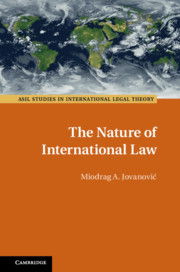
Miodrag A. Jovanović
The Nature of International Law
Cambridge University Press – 2019
(*some minor grammatical and changes have been introduced in order to make the reading more fluid, but in no way altering the content or the format of each speaker’s interventions).
The HAPL podcast is powered by the EU Horizon Twinning project “Advancing Cooperation on The Foundations of Law – ALF” (project no. 101079177). This project is financed by the European Union.